


Quick answer: We checked eight popular claims about Dubai real estate since regional conflict escalated on 28 February against official and professional data. Four are not supported: prices have not crashed 30–50% (the valuation index is about 10% below February), residents did not leave en masse (population dipped about 61,000 in March and was back above its starting level by June), developers have not stopped building (24,800 homes were completed in the first half), and banks have not stopped lending. Four are partly true or depend on the segment: tourism was hit hard but is recovering, sales are far below last year even though nine-month totals are still the second-highest on record, distress sales are real but limited, and rents are falling for new leases in some communities while renewals barely move.
This article is about market data, not about the conflict itself. What has happened in the region has a real human cost, and that is not our subject. The question here is narrower: when people say things about Dubai property, does the evidence support them?
Since February, Dubai property has attracted two kinds of confident claims. Some say the market has collapsed, that everyone has left and nobody is buying. Others say nothing has changed at all. Both are easy to repeat and neither survives contact with the numbers. Below, each claim gets a verdict and the evidence behind it.
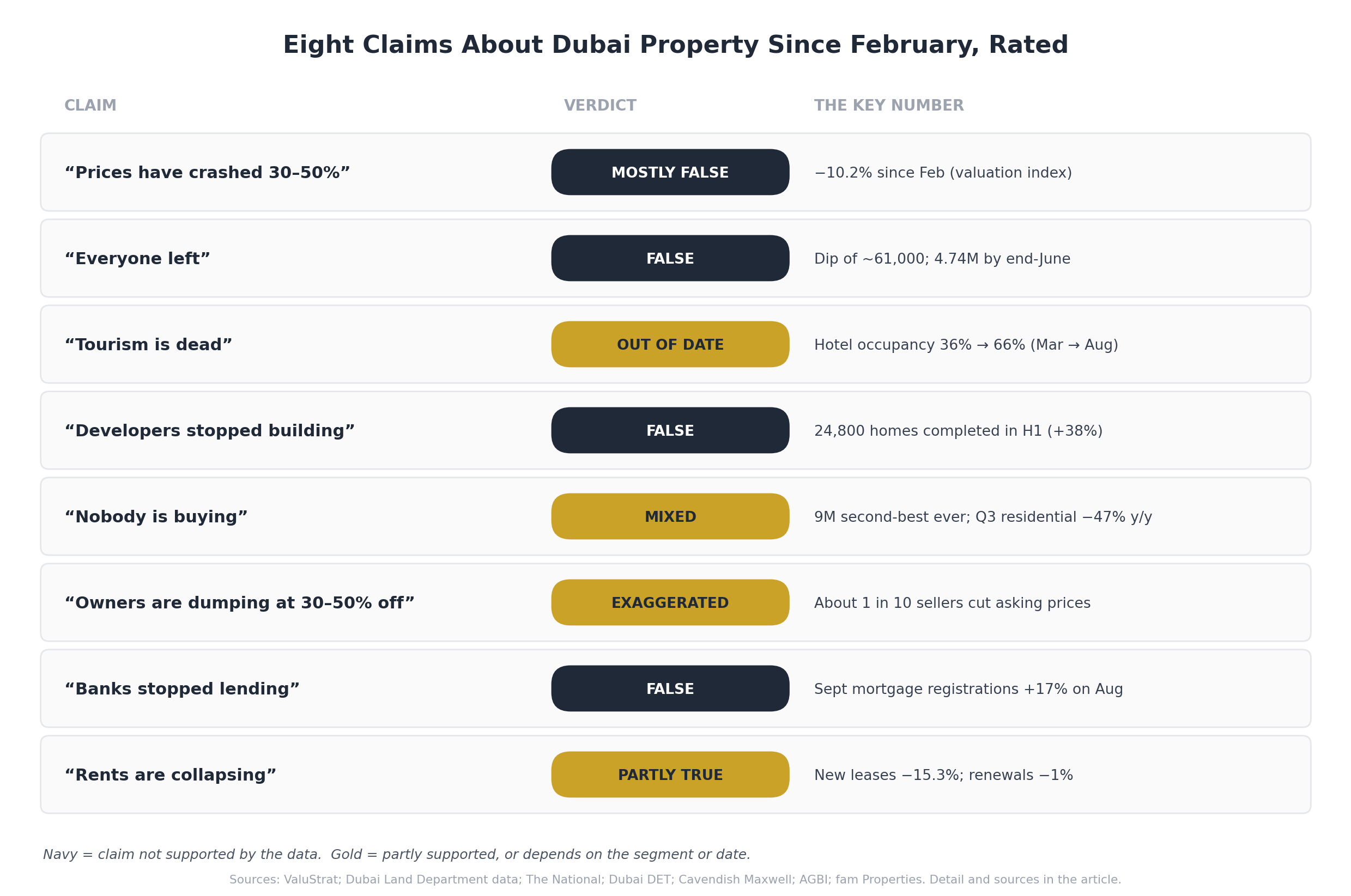
Fig. 1 — Eight claims, eight verdicts. Navy means the claim is not supported by the data; gold means it is partly supported or depends on the segment or date. Sources are cited in each section below.
Claim 1: "Prices have crashed 30–50%." Verdict: mostly false
The best available gauge of prices is the ValuStrat Price Index, compiled by RICS-registered valuers. In August it stood 10.2% below its February level and 3.1% below August 2025. The monthly pace of decline has slowed from 5.9% in March to 0.2% in August. That is a meaningful reset, but it is nowhere near a halving.
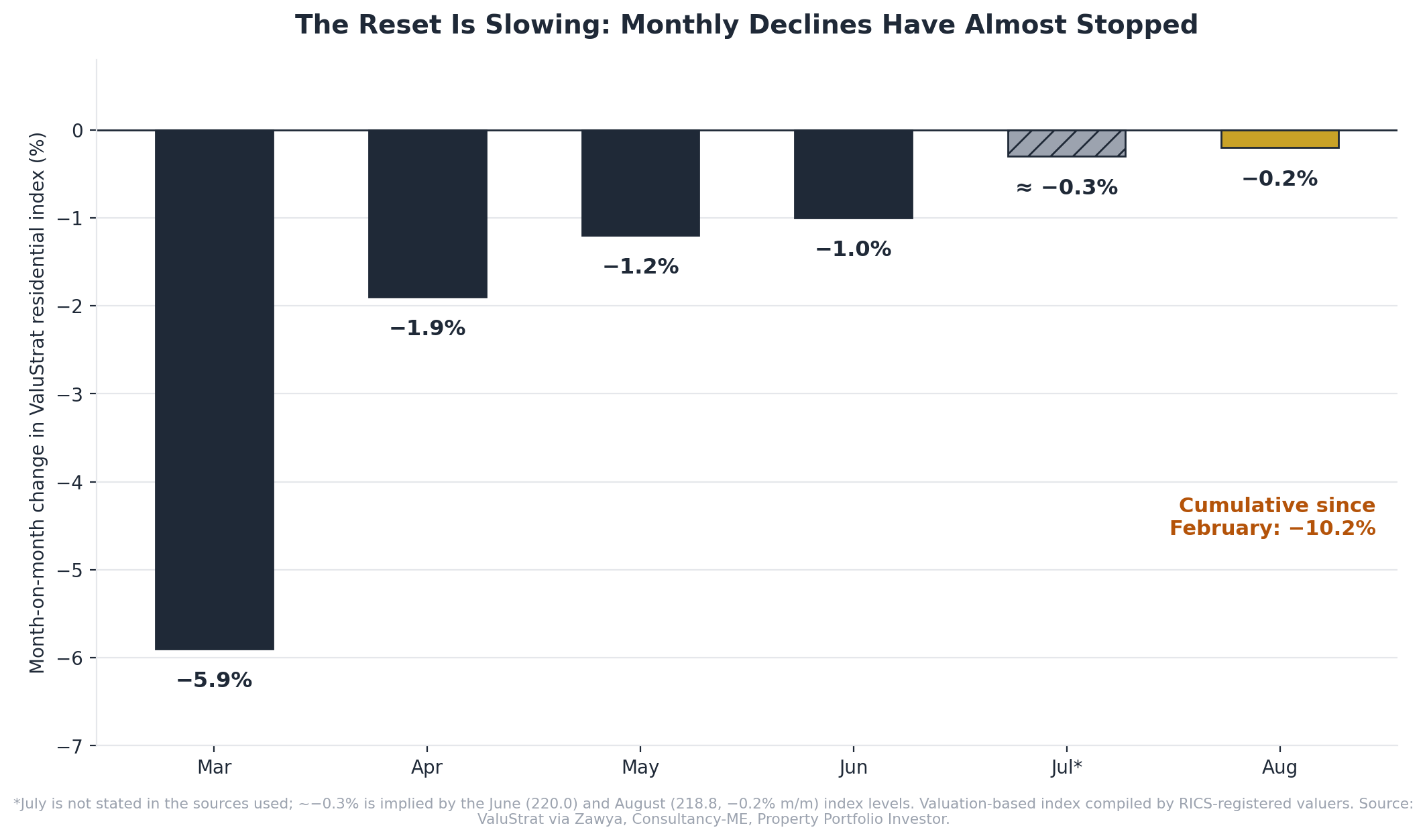
Fig. 2 — Monthly changes in ValuStrat's residential index. *July is implied by the June and August index levels. Source: ValuStrat via Zawya, Consultancy-ME and Property Portfolio Investor.
Where the claim has a kernel of truth is at specific addresses. ValuStrat's community data shows the Burj Khalifa district's apartments down 20.4% on the year and Jumeirah Beach Residence down 16.9%, and individual sellers have cut prices by more than the index. But citywide, the 30–50% figure is not in any professional dataset we found.
Claim 2: "Everyone left." Verdict: false
Official figures from the Dubai Population Now platform show the population dipped by about 61,000, or 1.3%, in March to 4.65 million. By the end of June it had risen to 4.74 million, with almost 40,000 added in June alone, leaving the emirate with about 157,000 more residents than at the start of the year. Annual growth had been running at 6–7% since the pandemic.
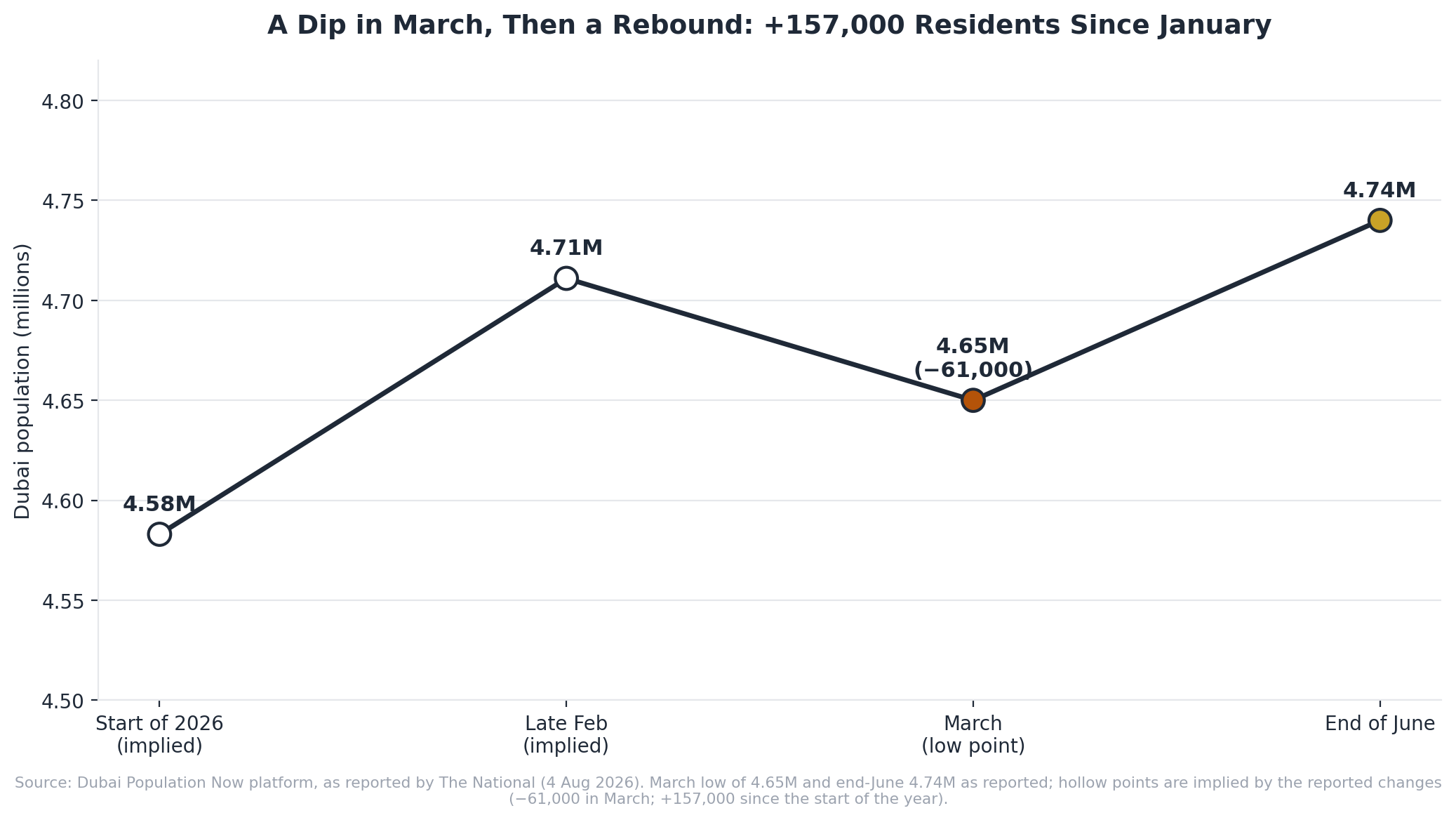
Fig. 3 — Dubai's population dipped in March and recovered by June. Source: Dubai Population Now, as reported by The National, 4 August 2026. Hollow points are implied by the reported changes.
The dip was real, and for the families who left it was not a statistic. But it was temporary and small relative to the base, and the figures since show the city growing again.
Claim 3: "Tourism is dead." Verdict: out of date
This was fair in March, when hotel occupancy fell to 36%. It is not fair now. Dubai's Department of Economy and Tourism reports 6.97 million international overnight visitors in the first eight months of 2026, with about 869,000 in August, the best month since February. Hotel occupancy reached 66% in August, which is 89% of the level a year earlier, and Emirates had restored roughly 85% of its pre-conflict capacity by mid-August.
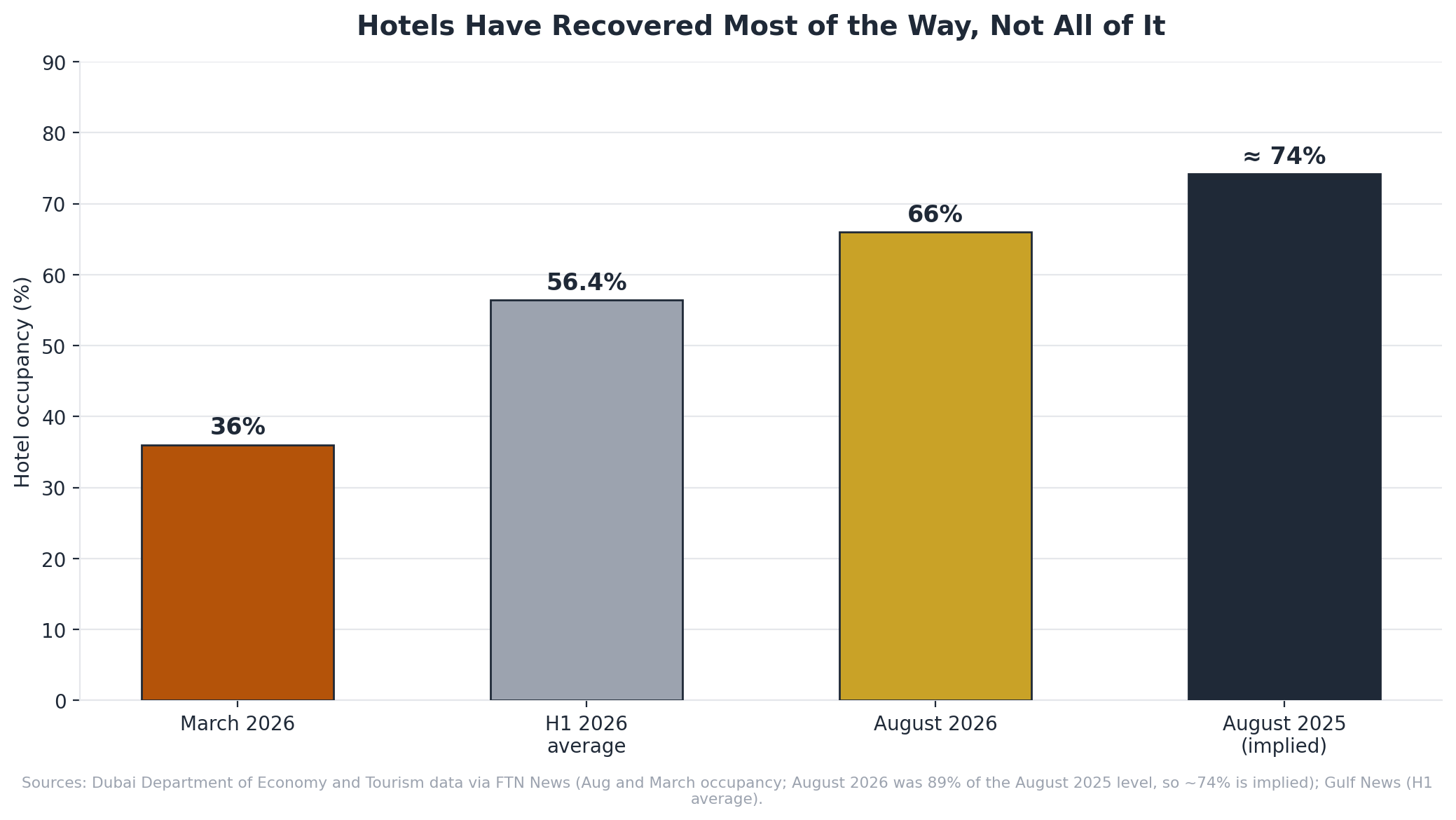
Fig. 4 — Hotel occupancy has recovered most of the way but remains below last year. Sources: Dubai DET via FTN News; Gulf News (H1 average). August 2025 is implied from the 89% comparison.
The honest summary is "recovering, not recovered". The first-half average occupancy of 56.4% and a 7% fall in average daily rate to Dh701 show how deep the earlier damage was, and August's 66% is still below last year.
Claim 4: "Developers stopped building." Verdict: false
Construction has not stopped. Cavendish Maxwell counted 24,800 homes completed in the first half of 2026, up about 38% on a year earlier and the strongest half-yearly delivery in several years. (CBRE counts about 18,000 for the same period; the two firms define completions differently.) What did slow is the pace of new launches, which fell after record volumes in 2024 and 2025, and some developers delayed projects in the second quarter.
The real concern is delays rather than a halt. About 47,000 homes are scheduled for completion in the second half, but based on historical delivery rates Cavendish Maxwell expects only 14,000–23,500 to actually arrive. For anyone waiting on a handover, that gap matters more than any headline about construction stopping.
Claim 5: "Nobody is buying." Verdict: mixed
The claim is wrong in one sense and right in another. Dubai recorded AED 379.4 billion in sales across 123,416 transactions in the first nine months of 2026, the second-highest nine-month total on record. September's AED 29.66 billion was about 6% higher than August's.
Against last year, though, the slowdown is large. Cavendish Maxwell puts third-quarter residential sales at about AED 72.6 billion, down 47% in value and 38% in volume on the same quarter of 2025, and says part of the fall reflects the lag between agreeing a purchase and registering it. In August, ValuStrat's analysis showed off-plan registrations 40.4% lower than a year earlier. Both statements are true: the market is still historically busy, and it is well below last year's record pace.
Claim 6: "Owners are dumping property at 30–50% off." Verdict: exaggerated
Distress is real but concentrated. AGBI reported in May that about a tenth of sellers had cut asking prices since the conflict began, some by large amounts, and that listings circulating in agent WhatsApp groups advertised "urgent sale" discounts of 10–50% on off-plan units ahead of handover. Emaar's founder said requests for payment delays rose during the conflict before easing.
Two cautions apply. First, these are asking prices and advertised discounts, not completed sales, and broker marketing tends to showcase the deepest cuts. Second, if deep discounts were widespread they would show up in the valuation index, which has fallen about 10%. Distressed sellers exist, particularly among investors who bought several off-plan units and are now facing payment calls, but they are not the market.
Claim 7: "Banks stopped lending." Verdict: false
Mortgage registrations were AED 16.79 billion across 4,266 transactions in September, about 17% higher by value than August, and AED 151.13 billion across 34,910 transactions in the first nine months. Lending is continuing. The change is in cost rather than availability: the Fed raised rates in September and the UAE followed, which we cover in our guide to what the hike means for Dubai mortgages.
Claim 8: "Rents are collapsing." Verdict: partly true
It depends on whether you are signing a new lease or renewing, and where. Dubai Land Department data analysed by fam Properties shows new-lease rents running 15.3% below January levels while renewal rents have fallen only about 1%. CBRE recorded a 6.2% quarter-on-quarter fall in residential rents in the second quarter. In August, new leases outnumbered renewals for the first time since tracking began in January 2023. But the softening is concentrated in high-supply apartment communities, and prime and villa areas look very different. We unpack the detail in our piece on why tenants are gaining leverage.
Where the Pessimists Have a Point
- Residential values are about 10% below February, and some well-known tower addresses have fallen far more.
- Sales are well below last year's record pace, and off-plan registrations in particular fell sharply in August.
- A large supply wave is arriving, concentrated in apartments, with 162,500 units scheduled for 2027 (though historically far fewer are delivered on time).
- Borrowing is getting more expensive, with a majority of Fed officials projecting another increase this year.
- Some regional risks remain unresolved, and sentiment has been sensitive to them all year.
Where the Optimists Overreach
- "Nothing has changed" ignores a 10% valuation reset and a 47% year-on-year fall in third-quarter residential sales.
- "Prices are about to bounce" ignores that monthly declines, though small, are still declines, and that supply and financing costs are moving the wrong way for a quick recovery.
- "The whole city is fine" ignores the widening gap between communities that are growing and those that are falling.
The Bottom Line
The most dramatic claims about Dubai property in 2026 do not survive a check against the data, and neither does blanket reassurance. The picture that does survive is more specific: a roughly 10% price reset that has largely stopped deepening, a population and tourism recovery under way, activity well below last year's record, and a market whose outcomes now depend heavily on the community, the price point and the financing. If you read one rule into all of it, it is to ask for the number behind any claim, and to be wary of any claim that only ever points one way.
Not sure how a claim you have heard applies to your own building or budget? Get in touch and we will show you the data for your situation. For more detail on the market, see our September 2026 market review and our data review of how the market behaved through the conflict.
Frequently Asked Questions
Did Dubai property prices crash in 2026?
No. The ValuStrat Price Index shows residential values about 10.2% below their February 2026 level in August and 3.1% below a year earlier, with the monthly decline slowing to 0.2%. Some individual addresses and sellers have seen much larger falls, but a 30–50% citywide crash is not in the professional data.
Did people leave Dubai during the conflict?
Some did. Official figures show Dubai's population dipped by about 61,000, or 1.3%, in March to 4.65 million. By the end of June it had recovered to 4.74 million, about 157,000 higher than at the start of the year.
Is Dubai tourism back to normal?
Not fully, but it is recovering. Hotel occupancy rose from 36% in March to 66% in August, which is 89% of the August 2025 level, and Dubai received 6.97 million international overnight visitors from January to August.
Are Dubai property developers still building?
Yes. Cavendish Maxwell counted 24,800 homes completed in the first half of 2026, up about 38% on a year earlier. New launches slowed, and handovers scheduled for the second half are expected to arrive at well under the 47,000 scheduled, so delays are the main risk.
Is Dubai real estate recovering after the conflict?
Parts of it are. Price declines have slowed sharply, population and tourism have rebounded, and September sales value and mortgage registrations rose on August. But sales remain far below last year's record pace and performance varies widely between communities, so "recovering" depends on what and where you are looking at.
Ratings reflect the best published data available on 6 October 2026. Sources define and count categories differently, and several figures (including ValuStrat's valuation-based index and the implied points in our charts) are not average transaction prices. This article is for general information only and is not investment advice, nor commentary on the conflict itself.
