



Quick answer: Dubai residential values are about 10.2% below their February 2026 level, according to the ValuStrat Price Index, and 3.1% lower than a year ago — but the monthly pace of decline has slowed from 5.9% in March to just 0.2% in August. September's Dubai Land Department data shows AED 29.66 billion in sales across 11,430 transactions (up about 6% in value on August) and AED 16.79 billion in mortgage registrations (up roughly 17%). Year-on-year, activity is still well below last year's record pace, and performance varies sharply by community: some villa enclaves and affordable apartment districts are still growing while the most famous tower addresses have fallen hardest.
If you only read headlines about Dubai property this year, you could be forgiven for being confused. One set of numbers says the first nine months of 2026 are the second-strongest on record. Another says prices are down about a tenth since February. Both are true, and the gap between them is the real story of the market heading into the fourth quarter: a genuine price reset, a slowdown that is flattening out rather than deepening, and a market where where you buy now matters far more than whether you buy.
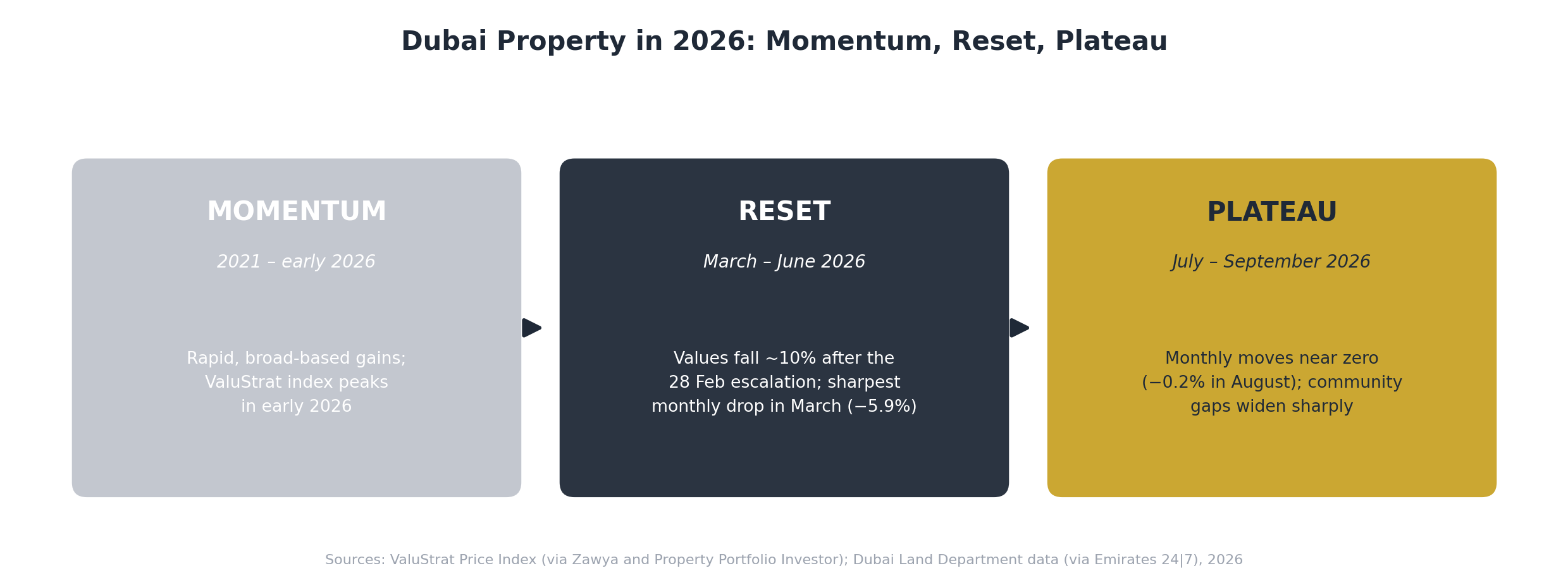
Fig. 1 — Dubai property in 2026: from broad momentum, to a roughly 10% reset after the 28 February escalation, to a plateau in which monthly moves are close to zero. Sources: ValuStrat Price Index; Dubai Land Department data.
The Price Reset: 10.2% Since February
The most useful price gauge right now is the ValuStrat Price Index (VPI). It is compiled by RICS-registered valuers who mark a sample of properties representing more than 90% of Dubai's residential and commercial markets, which makes it valuation-based rather than transaction-driven — in other words, it reacts faster than sales data does. In August the residential index stood at 218.8 points, which is 10.2% below its February level and 3.1% below August 2025. The citywide weighted average residential value is now about AED 3.36 million, or AED 1,513 per square foot.
The index began falling after regional conflict escalated on 28 February (we cover how the market has behaved through that episode in our data review of Dubai real estate and regional conflict). The sharpest monthly fall came in March at 5.9%. What has changed since is the pace.
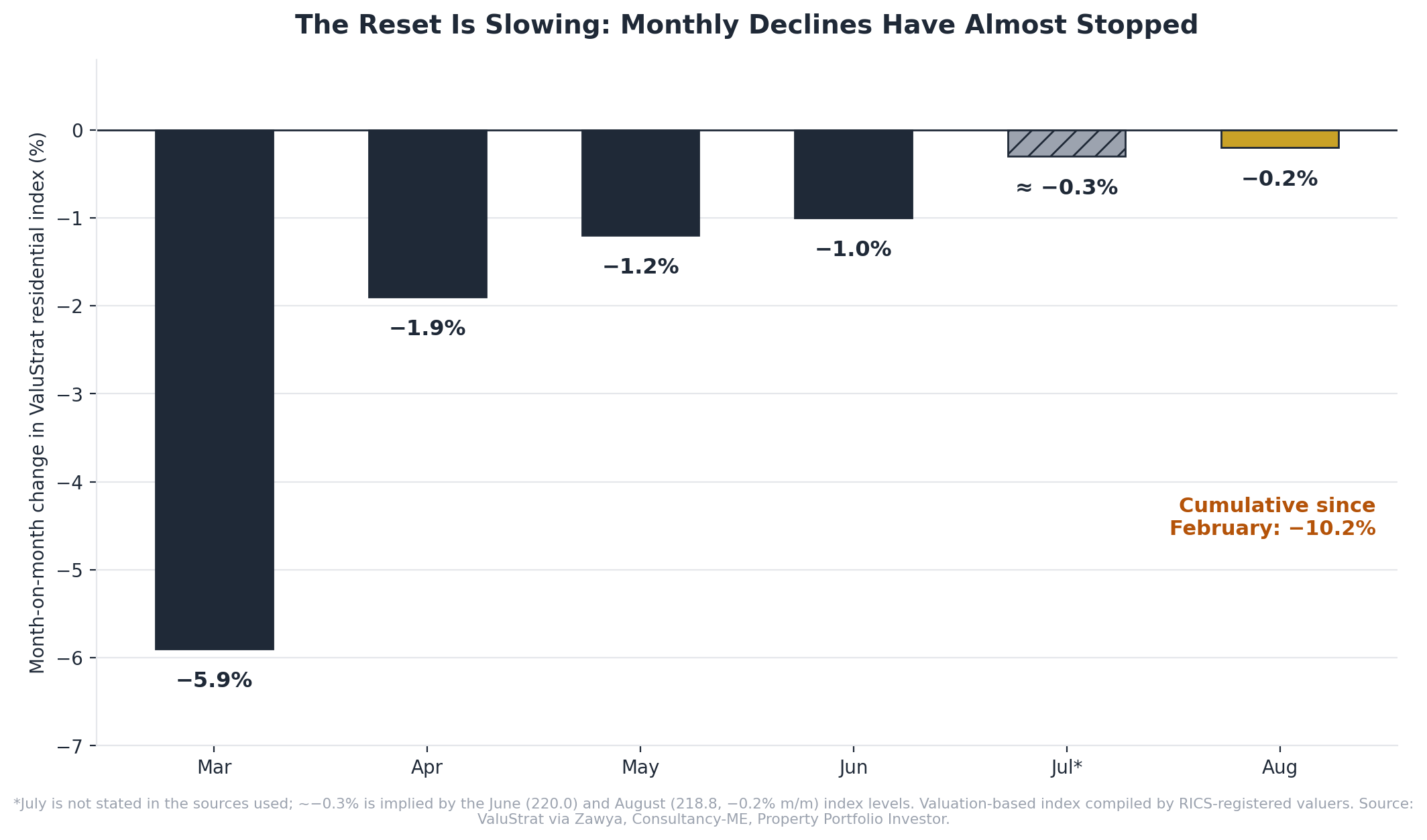
Fig. 2 — Monthly declines in the ValuStrat residential index have shrunk from 5.9% in March to 0.2% in August. *July is not stated in the sources used; the roughly 0.3% shown is implied by the June and August index levels. Source: ValuStrat via Zawya, Consultancy-ME and Property Portfolio Investor.
A 10% reset over six months is meaningful — it is not a rounding error, and it follows forecasts earlier in the year that pointed to double-digit growth. Those forecasts were published days before the February escalation and have been overtaken by events. But the shape of the curve matters just as much as the total: a market that fell 5.9% in one month and 0.2% in another is behaving very differently from one that is still in free fall.
Volumes: August Low, September Partial Rebound
Dubai Land Department figures published on 1 October put September sales at AED 29.66 billion across 11,430 transactions (9,744 residential units, 777 buildings and 910 land plots). That is slightly fewer transactions than August's 11,600, but about 6% more value (August: AED 27.89 billion) — the average sale rose to roughly AED 2.6 million. June, the strongest month since April, remains the most recent peak.
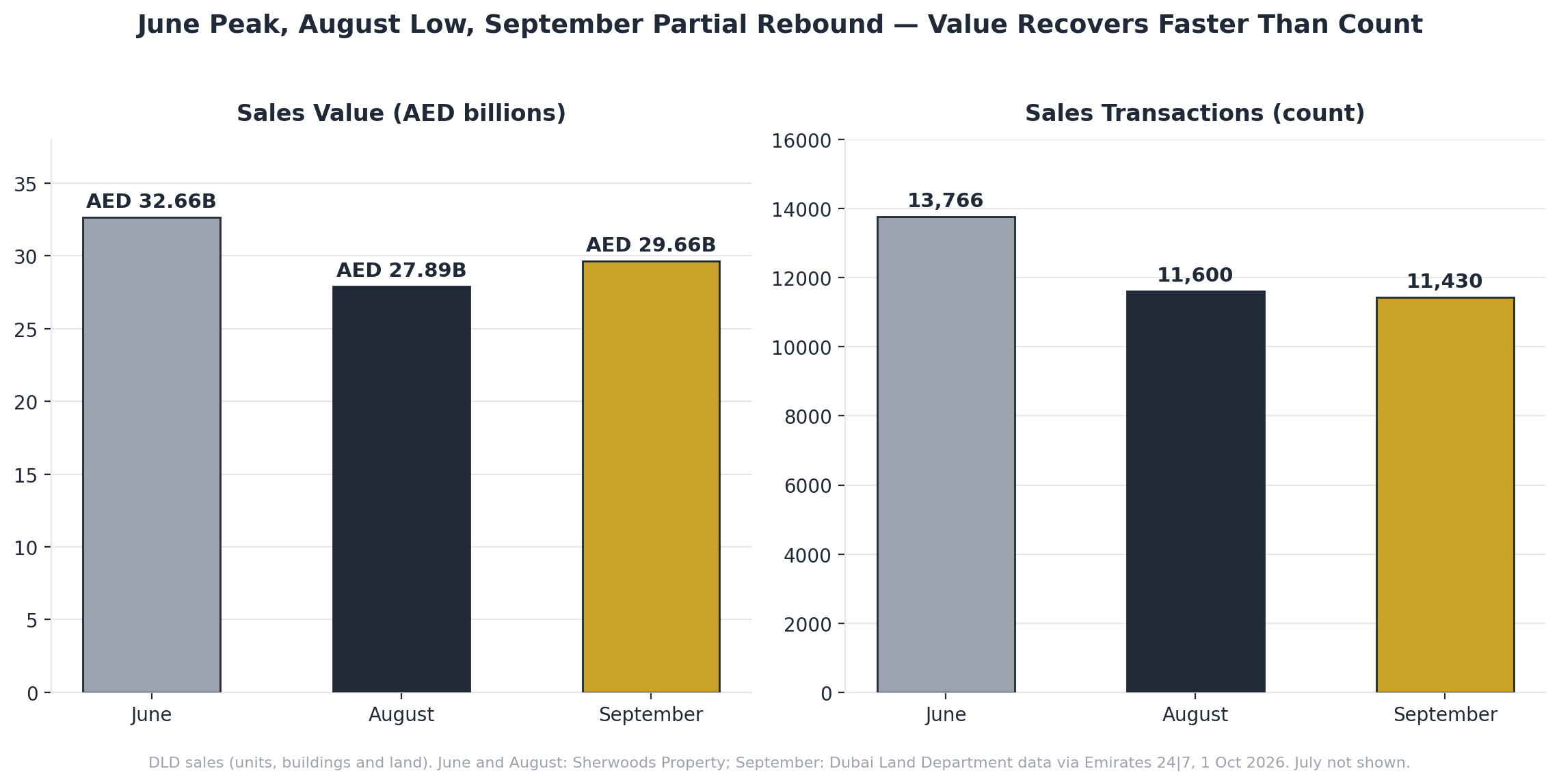
Fig. 3 — Sales value has recovered faster than transaction count since August's low. Sources: Sherwoods Property (June, August); Dubai Land Department data via Emirates 24|7, 1 October 2026 (September).
Financing is the clearest improvement. Mortgage registrations reached AED 16.79 billion across 4,266 transactions in September, against AED 14.36 billion across 3,390 in August — roughly 17% more by value. Gifts added AED 4.33 billion, taking total real estate transactions in September to AED 50.78 billion across 16,490 deals. For the year to date, sales stand at AED 379.4 billion across 123,416 transactions, the second-highest nine-month total on record.
The honest caveat is the comparison with last year. 2025 was a record, and against it the slowdown is real: one broker analysis of DLD data puts third-quarter 2026 sales at roughly AED 92.3 billion against AED 169 billion a year earlier — about 45% lower. In August specifically, ValuStrat's tally of DLD data showed ready-home sales down 20.6% on a year earlier and off-plan registrations down 40.4%. "Second-highest on record" and "well below last year" are both accurate descriptions of the same market.
Ready Homes Have Caught Up With Off-Plan in Value
One structural shift hides inside the totals. Off-plan still dominates by count: 84,090 of the year's sales to September, around two-thirds of the total. But ready property has pulled ahead by value — AED 196.08 billion against AED 183.32 billion off-plan for January to September — because completed homes carry higher average prices. September repeated the pattern, with ready sales of AED 16.03 billion against AED 13.63 billion off-plan. If you judge the market by deal count alone you will overstate how much of it is new-launch activity.
Two Markets in One City: Community Winners and Losers
Citywide averages hide the most important feature of the market in 2026, which is dispersion. ValuStrat's August data shows villa values 1.7% lower on the year — the first annual decline for the segment since 2021 — and apartments 5.3% lower. Underneath those averages, the gaps between communities are enormous.
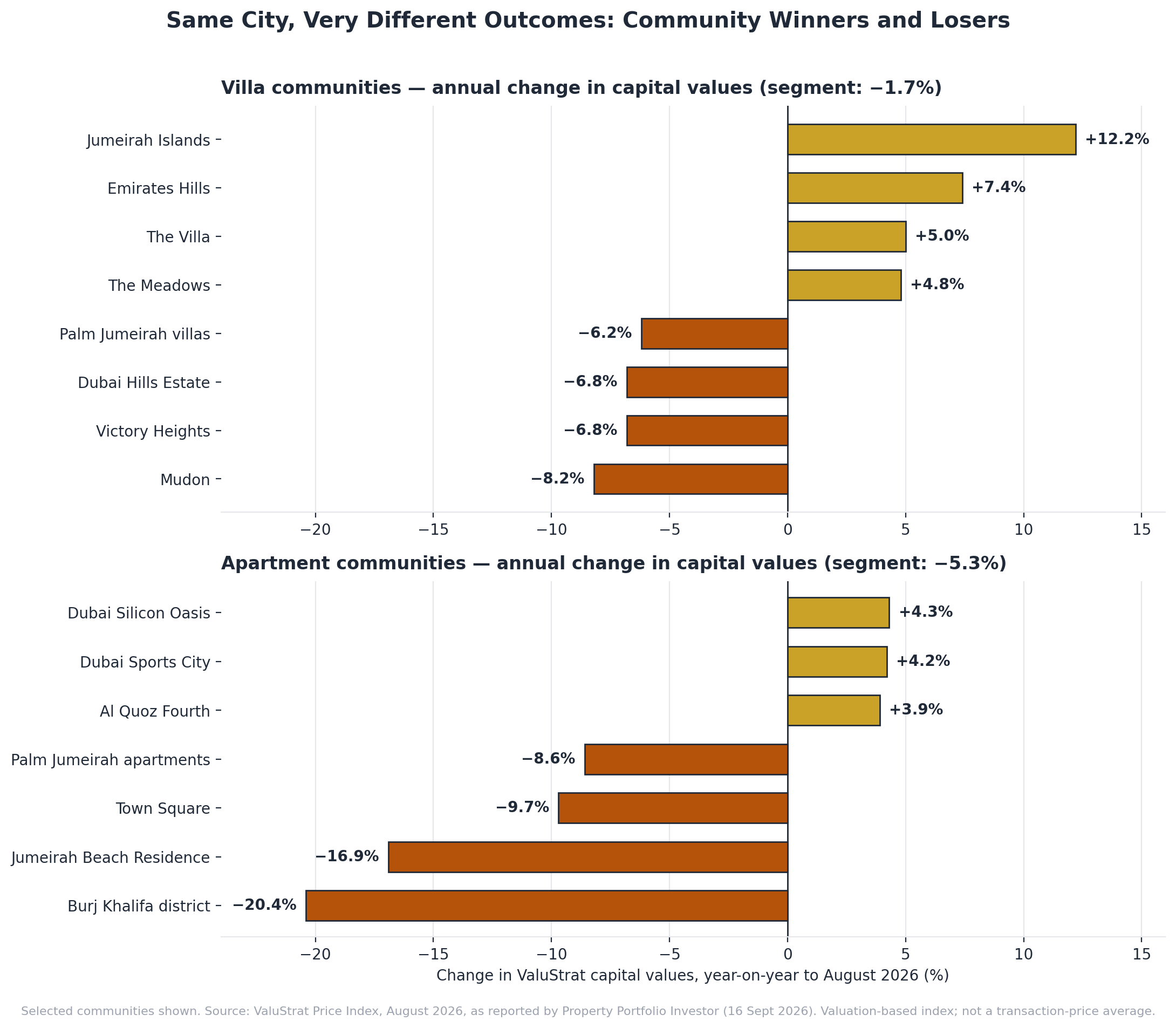
Fig. 4 — Selected villa and apartment communities, annual change in capital values to August 2026. Source: ValuStrat Price Index as reported by Property Portfolio Investor, 16 September 2026.
Among villas, Jumeirah Islands (+12.2%), Emirates Hills (+7.4%), The Villa (+5.0%) and The Meadows (+4.8%) are still growing, while Mudon (−8.2%), Dubai Hills Estate and Victory Heights (each −6.8%) and Palm Jumeirah villas (−6.2%) have slipped. Among apartments the pattern is striking: the best performers are affordable, workaday districts — Dubai Silicon Oasis (+4.3%), Dubai Sports City (+4.2%) and Al Quoz Fourth (+3.9%) — while the most famous addresses have fallen furthest, including the Burj Khalifa district (−20.4%) and Jumeirah Beach Residence (−16.9%). The entry-price gap explains part of this: a typical Dubai Silicon Oasis unit is valued at around AED 669,000, against about AED 2.85 million in the Burj Khalifa district.
It is worth keeping the dispersion in proportion. ValuStrat reports that 73% of freehold villa communities and 61% of freehold apartment communities were stable over the year — the market is not falling apart, it is sorting itself out.
What About Rents?
Rents are following the same logic. In August new residential leases outnumbered renewals for the first time since the Land Department began tracking in January 2023, and new-lease rents are running well below January levels while renewals have barely moved. We break that down community by community in our piece on why tenants are gaining leverage.
What to Watch in the Fourth Quarter
- Whether monthly price moves stay near zero. August's 0.2% decline is the best reading since the reset began. A return to monthly falls of 1% or more would change the picture; a flat or positive month would be the first real sign of a floor.
- Off-plan registrations. A 40% annual drop in August is the weakest data point in the market. Whether September's stronger count is the start of a recovery or a seasonal bounce is the main open question for new-launch pricing.
- Mortgage activity. September's rise suggests financed buyers are returning. Sustained growth would be a healthier sign than cash-driven top-end deals alone.
- Regional tensions. Conditions in the wider region remain the largest source of uncertainty and have driven sentiment this year.
- The supply pipeline. Roughly 162,500 homes are scheduled for delivery in 2027, concentrated in mid-market apartment communities.
What This Means for You
- Buying? The days of broad-based gains are over, which cuts both ways: you have more negotiating room than in 2024 or 2025, but the cost of picking the wrong community is higher. Compare the specific building and community against its own price history rather than the citywide average.
- Financing a purchase? Mortgage registrations are rising and ready homes now account for more than half of sales by value. Ready stock is where lending actually happens; off-plan is typically funded through developer payment plans.
- Selling? Pricing realistically matters more than it did a year ago, especially in tower addresses where values have fallen most. Villa owners in communities with positive annual growth are in a very different position from owners in those with falls.
- Investing for income? With capital growth no longer a given, the case rests on entry price and rental yield. Affordable districts have been the strongest performers this year.
- Renting? The leverage described above is real but concentrated in high-supply communities, and it narrows as the autumn season returns.
The Bottom Line
Dubai's market in September 2026 is neither a collapse nor a continuation of the boom. Values have reset by roughly 10% from February, the pace of decline has almost stopped, and sales value and mortgage activity both improved in September — but volumes remain well below last year's record and the gap between the best and worst communities has rarely been wider. For buyers, sellers and investors alike, the useful question has changed from "is Dubai up or down?" to "is this community, at this price, up or down?"
Want a read on how a specific building or community compares? Get in touch and we will show you the data for your situation rather than the citywide average. For the detail behind the headline numbers, see our full breakdown of August's transactions.
Frequently Asked Questions
Are Dubai property prices falling in 2026?
Yes, but the fall is flattening. The ValuStrat Price Index is about 10.2% below its February 2026 level and 3.1% lower than a year earlier, but monthly declines have shrunk from 5.9% in March to 0.2% in August. The picture varies widely by community.
How much have Dubai property prices fallen since February 2026?
According to ValuStrat's valuation-based index, residential capital values were 10.2% lower in August 2026 than in February. The index measures valuations of a representative sample of properties rather than average sale prices, so it can differ from figures based on transaction data.
How many property sales did Dubai record in September 2026?
Dubai recorded 11,430 sales worth AED 29.66 billion in September 2026, according to Dubai Land Department data reported on 1 October. Including mortgages and gifts, total real estate transactions were AED 50.78 billion across 16,490 deals. Different trackers define and count categories slightly differently, so totals can vary by source.
Which Dubai communities are still growing in value?
In ValuStrat's August data, villa communities including Jumeirah Islands (+12.2% year-on-year), Emirates Hills (+7.4%), The Villa (+5.0%) and The Meadows (+4.8%) were still growing, as were affordable apartment districts such as Dubai Silicon Oasis (+4.3%) and Dubai Sports City (+4.2%). The most famous tower addresses, such as the Burj Khalifa district (−20.4%), fell furthest.
Is now a good time to buy property in Dubai?
It depends on the community, the price and your time horizon. Buyers currently have more negotiating room than during the boom, and monthly price falls have almost stopped, but community-level performance varies enormously and conditions in the wider region remain uncertain. This article describes market data and is not personal advice.
Figures are drawn from Dubai Land Department data and ValuStrat research as reported by the outlets above. Sources define and count categories differently, so totals may vary slightly between them. The ValuStrat index is valuation-based and is not an average of transaction prices. This article is for general information only and is not financial or investment advice; verify current figures with the Dubai Land Department before making a decision.
