


Quick answer: Dubai's residential sales in the third quarter of 2026 were about AED 72.6 billion across roughly 34,000 transactions, down 47% in value and 38% in volume on the same quarter of 2025, according to Cavendish Maxwell. Other trackers report totals of AED 90–93 billion because they include commercial property and land. Three things help make sense of the numbers: the comparison is against a record quarter and partly reflects the lag between agreeing a purchase and registering it; activity is concentrated at lower price points and in newer communities, with Dubai South leading; and off-plan accounts for about two-thirds of deals but under 60% of value, while resale deals are fewer, larger and mostly paid in cash.
The third-quarter figures arrived within a day of each other in early October and, at first glance, they contradict one another. One says residential sales fell nearly half on last year. Another puts the quarter at AED 92.9 billion. A third says the first nine months were the second-strongest on record. All three can be right. This guide explains why, and what each number does and does not tell you.
The Headline: Down 47%, Against a Record
Cavendish Maxwell counted residential sales of AED 72.6 billion across about 34,000 transactions in Q3 2026. That is 47% lower in value and 38% lower in volume than the same quarter of 2025. Over the first nine months, residential sales reached AED 292 billion from 112,580 transactions, which is 27% lower in value and 23% lower in volume than the same period of last year.
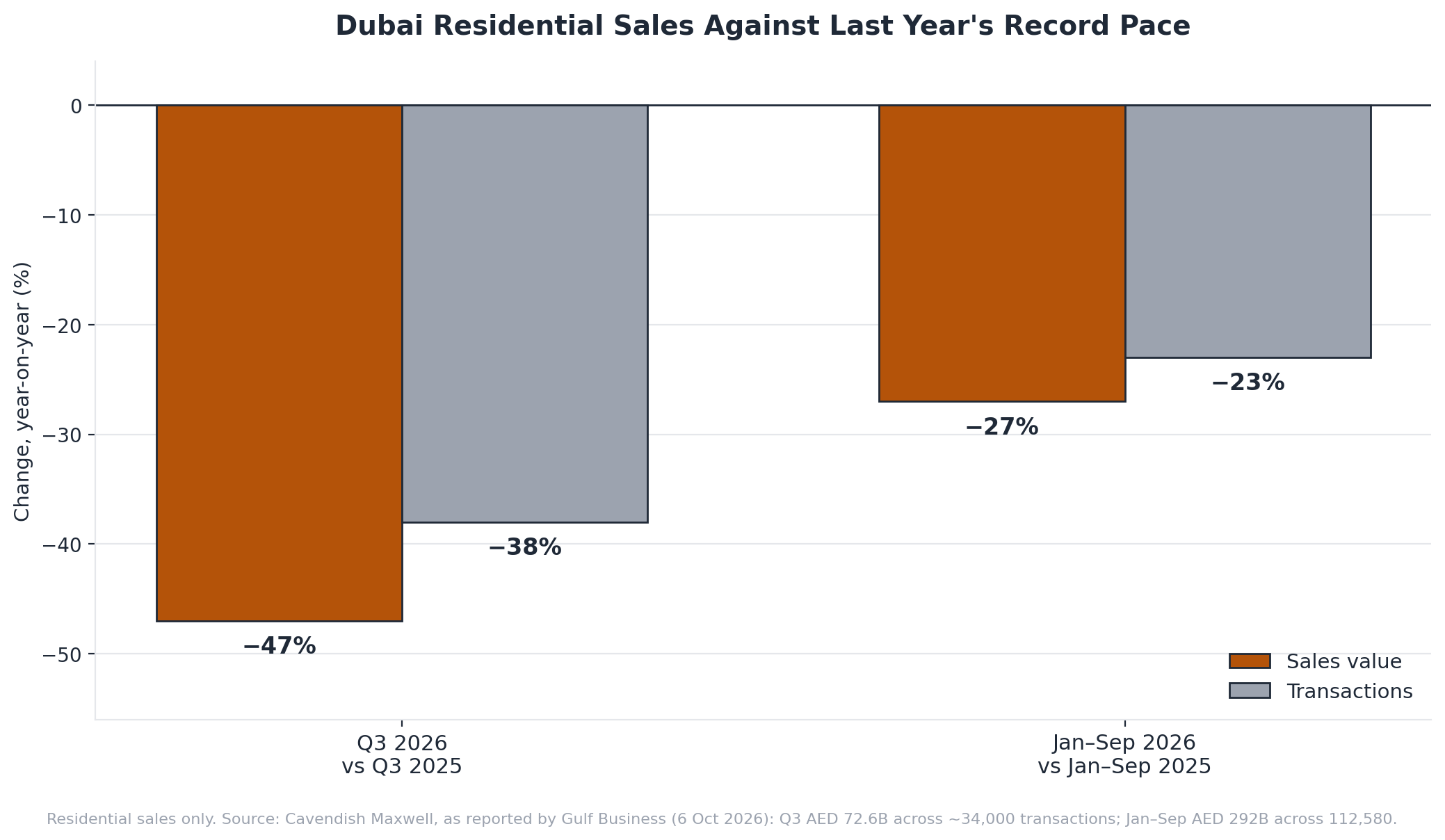
Fig. 1 — Residential sales against last year. Source: Cavendish Maxwell, as reported by Gulf Business, 6 October 2026.
Two pieces of context matter. First, last year was a record: 2025's total real estate transactions reached about AED 919 billion, and the first nine months of 2026 (AED 574 billion including mortgages and gifts) equal about 62% of that. A market can be down sharply on a record and still be historically busy, which is why "second-highest nine-month total on record" and "down 27%" describe the same period. Second, the comparison is not a measure of prices, which we cover below.
Why Four Trackers Give Four Totals
Every figure in circulation comes from Dubai Land Department registrations. The differences come from what each tracker chooses to count.
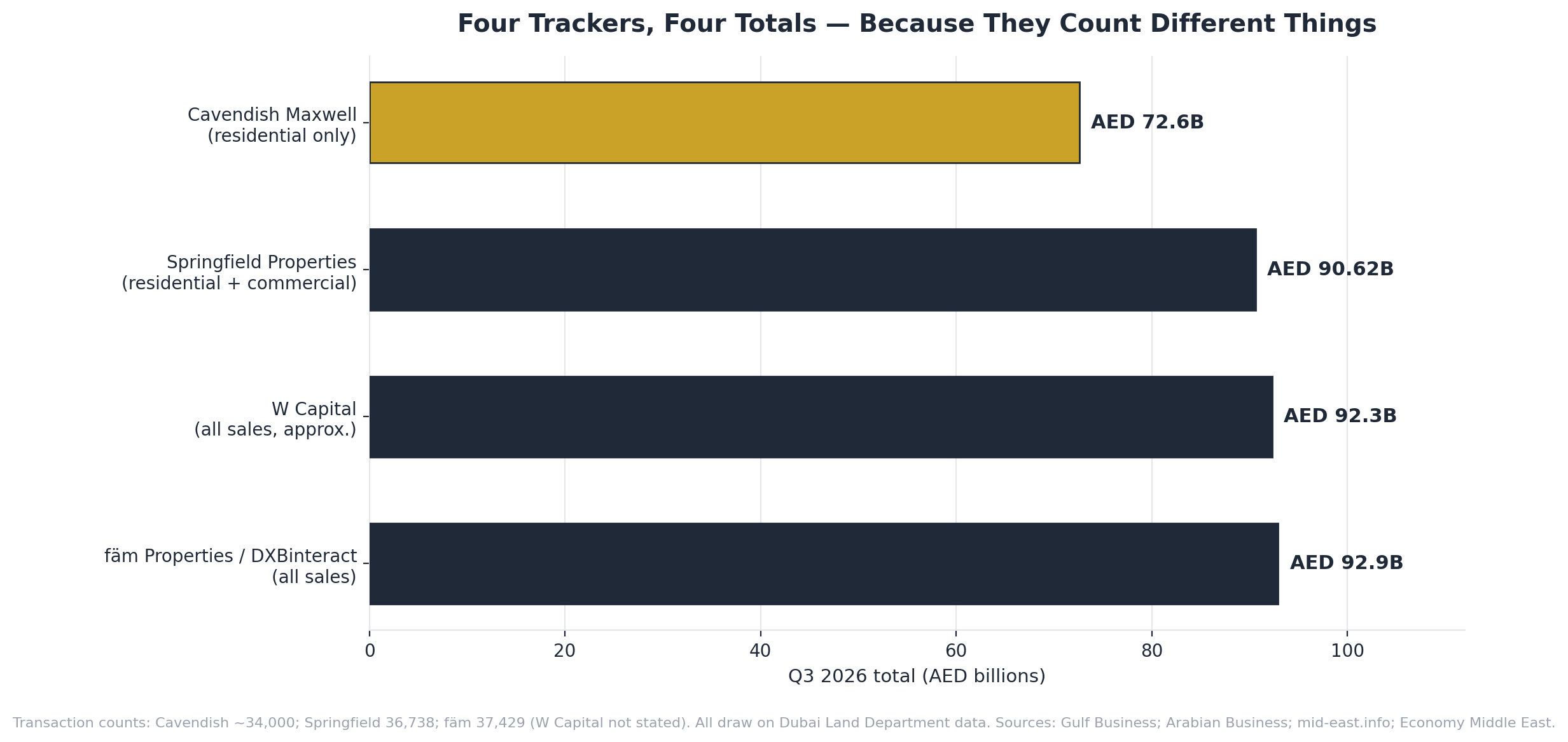
Fig. 2 — Q3 2026 totals by tracker. Cavendish Maxwell counts residential sales only; the others include commercial property and land. Sources: Gulf Business; Arabian Business; mid-east.info; Economy Middle East.
- Cavendish Maxwell: residential sales only, AED 72.6 billion across about 34,000 transactions.
- Springfield Properties: residential and commercial, AED 90.62 billion across 36,738 transactions, of which commercial was AED 18.04 billion across 2,789.
- fäm Properties (DXBinteract): all sales, AED 92.9 billion across 37,429 transactions.
- W Capital: all sales, roughly AED 92.3 billion, against about AED 169 billion in Q3 2025, a fall of about 45%.
The practical rule: compare like with like. A residential figure from one source should never be set beside an all-sales figure from another, and even the share of off-plan differs between trackers for the same reason (Cavendish puts off-plan at 65% of residential value and 72% of transactions; fäm, which counts all sales, has 57% and 68%). When you see a surprising number, check the scope before drawing a conclusion.
The Registration Lag: Why Q3 Looks Weaker Than September Feels
Cavendish Maxwell attributes part of the fall to the time between agreeing a purchase and formally registering it, which means quarterly data reflects "a mix of recent and earlier buying activity", in the words of its head of residential valuation. In other words, deals agreed in the cautious weeks after the conflict began in late February are still working their way through the registry.
That cuts two ways. It suggests third-quarter figures capture some of the weakest buying sentiment of the year, and that activity today may be running somewhat ahead of the published numbers. But it also means the published numbers cannot yet tell us how autumn buying is going. September's data points in a better direction than the quarter as a whole: Dubai Land Department sales were AED 29.66 billion, about 6% higher than August, and mortgage registrations rose 17%. We analysed that in our September 2026 market review.
Off-Plan and Resale Are Two Different Markets
Developer sales and resales behave differently, and the Q3 data shows how. In fäm Properties' figures, primary sales were 25,441 transactions worth AED 52.6 billion, and resales were 11,988 transactions worth AED 40.3 billion.
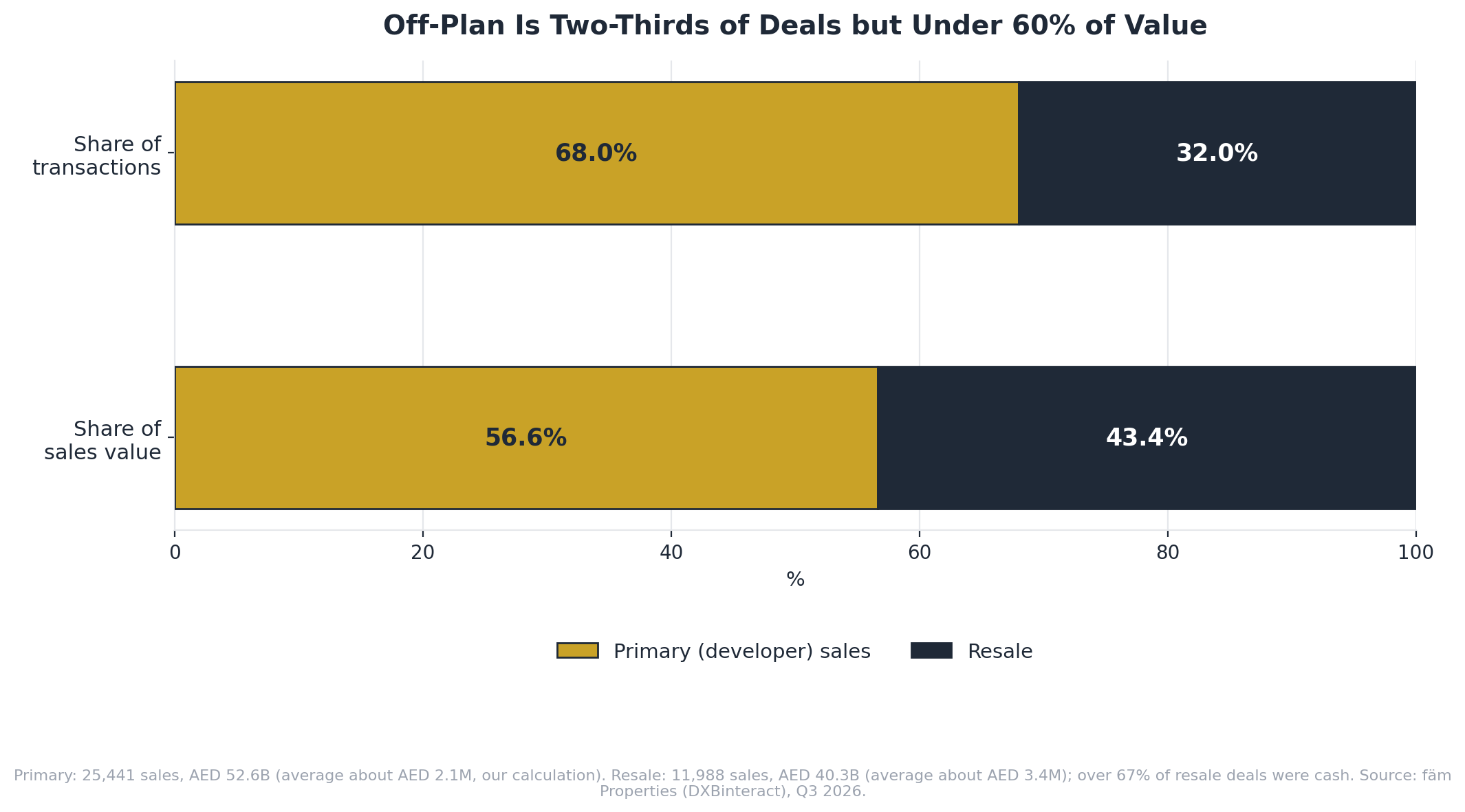
Fig. 3 — Primary versus resale share of Q3 2026 sales. Source: fäm Properties (DXBinteract) via Arabian Business and IndexBox. Average tickets are our calculation.
Primary sales made up about 68% of deals but 57% of value. Dividing value by count, the average developer sale was about AED 2.1 million while the average resale was about AED 3.4 million, roughly 60% higher. More than 67% of resale transactions were cash purchases. The resale market is therefore smaller by count but larger by ticket and heavily cash-driven, which is also why it is less sensitive to the interest-rate changes we discuss in our guide to the Fed hike and Dubai mortgages.
Property Finder's resale data adds a geographic twist: across January to August there were 40,963 resale transactions worth AED 153.4 billion, with capital moving away from established, higher-priced communities such as Business Bay, Downtown Dubai, Dubai Marina and Palm Jumeirah towards Mohammed Bin Rashid City, Dubai South and Jebel Ali.
Where the Deals Actually Are
The market's centre of gravity is lower price points. In fäm's data, 34.1% of Q3 sales were below AED 1 million and another 32.4% were between AED 1 million and AED 2 million, so two-thirds of deals were under AED 2 million. Only 8.3% were above AED 5 million. Springfield Properties' price-band data tells the same story from a slightly different angle: 84.28% of transactions below AED 3 million, up from 82.45% in the second quarter.
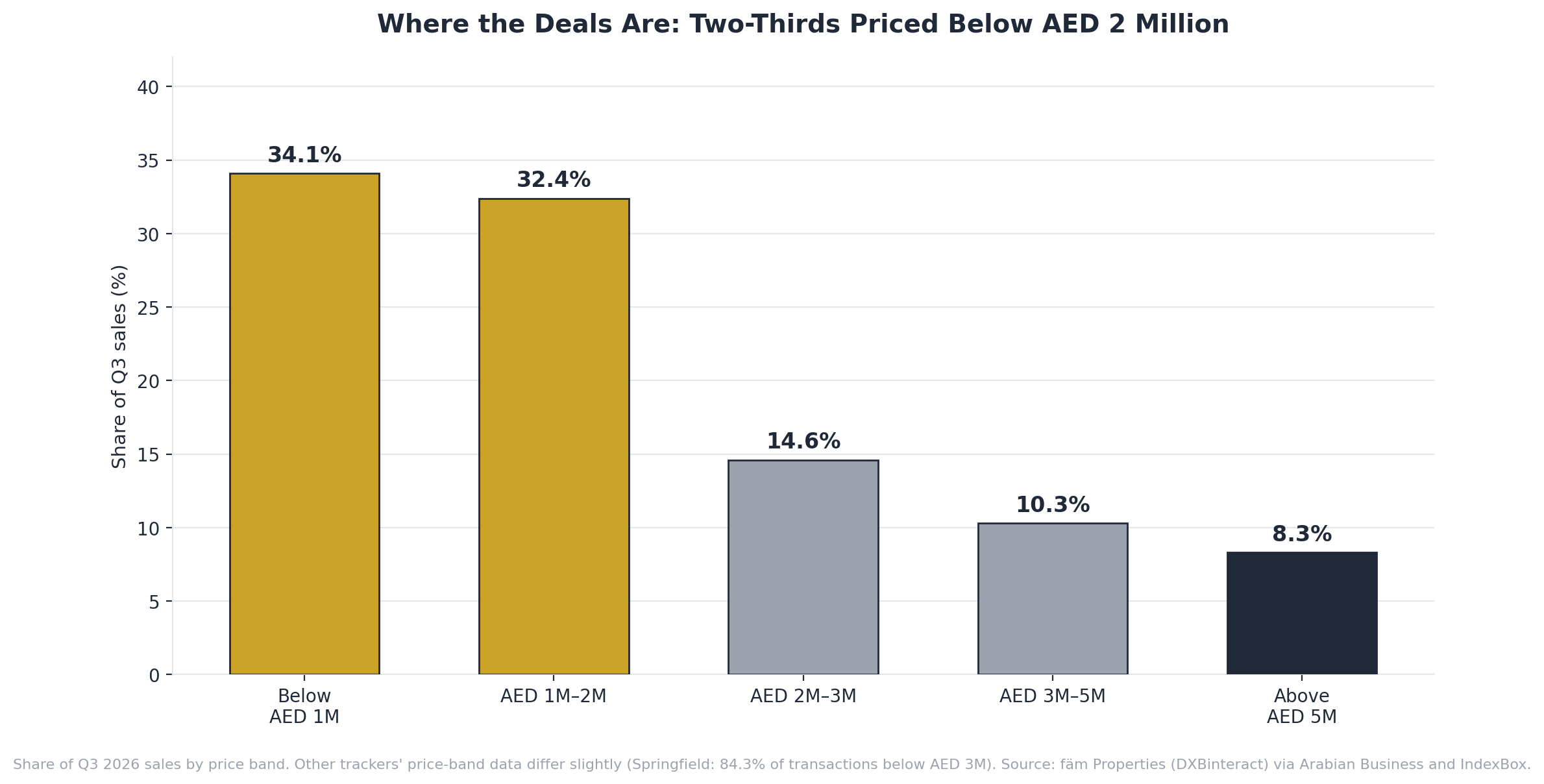
Fig. 4 — Share of Q3 2026 sales by price band. Source: fäm Properties (DXBinteract) via Arabian Business and IndexBox.
By location, Dubai South was the most active residential community in Q3 with 5,165 transactions at an average of about AED 1,690 per square foot, and fäm reports it topped off-plan sales for a seventh consecutive month, with 737 transactions worth AED 980.5 million in September. Downtown Jebel Ali ranked third with 1,890, and Business Bay, Dubai Creek Harbour and Dubai Marina remained among the most active. One caution from our August breakdown applies here: totals in fast-growing corridors can be dominated by single large launches, so a community's rank tells you where buyers registered deals, not necessarily where prices are rising.
At the very top end, the market still produces headline deals. fäm reports the most expensive villa sold in September at AED 260 million and the most expensive apartment at AED 71 million, but these sit at the thin end of a market where most deals are under AED 2 million.
What the Numbers Do Not Tell You
- They are not prices. Sales values mix everything that sold, so they move with the types of property transacted. ValuStrat's valuation-based index, which does track prices, shows residential values about 10.2% below February and 3.1% below a year ago as of August.
- They are not current sentiment. The registration lag means they describe buying that happened weeks or months earlier.
- They are not uniform. The gap between communities that are growing and those that are falling is wide, as we show in our August 2026 transactions breakdown and September review.
- They are not an average of what any one buyer will experience. A cash resale buyer in a prime tower and a mortgage-financed off-plan buyer in Dubai South face very different markets.
What to Watch in the Fourth Quarter
- The registration lag unwinding. If October and November registrations come in stronger than the quarterly trend, it will confirm that autumn buying has recovered ahead of the data.
- The pace of new launches. Cavendish Maxwell says near-term activity depends on launches, regional uncertainty and a broader normalisation in buyer activity.
- Financing costs. Rates rose in September and a further increase is possible, which matters most for mortgage-financed buyers of ready homes.
- Off-plan resilience. A 40% annual fall in off-plan registrations in August was the weakest data point of the summer; whether it improves is the main open question.
What This Means for You
- Buying under AED 2 million? You are in the part of the market where most deals happen, with the most competition from other buyers but also the most supply and the most negotiating room in high-supply communities.
- Buying or selling a resale home? You are in a smaller, cash-heavy market where tickets are larger and rate changes matter less, but community-level price differences matter more.
- Considering off-plan? Check the developer, the project and the payment plan rather than relying on the headline that off-plan is the majority of the market.
- Quoting statistics to clients, friends or colleagues? State the source and scope. "AED 72.6 billion" and "AED 92.9 billion" are both correct, for different things.
The Bottom Line
The Q3 numbers describe a market that is far below last year's record but still busy, whose weakest buying months are only now fully appearing in the data, and whose activity is concentrated at lower price points and in newer communities. The most useful habit when new figures appear is to ask three questions: what exactly was counted, what period does it actually reflect, and compared with what? Those three questions will sort most of the confusion in Dubai property statistics.
Want help reading the data for a specific community or budget? Get in touch and we will show you the numbers that apply to your situation. For the detail behind the mortgage side of the story, see what the Fed hike means for Dubai mortgages, and for the claims circulating about the market, see our fact-check of eight popular claims.
Frequently Asked Questions
How much did Dubai property sales fall in Q3 2026?
Cavendish Maxwell reports residential sales of about AED 72.6 billion across roughly 34,000 transactions in Q3 2026, down 47% in value and 38% in volume on Q3 2025. Over the first nine months, residential sales were AED 292 billion, down 27% in value and 23% in volume.
Why do different reports give different Dubai Q3 sales totals?
All draw on Dubai Land Department data but count different things. Cavendish Maxwell counts residential sales only (AED 72.6 billion), while others include commercial property and land and report AED 90–93 billion. Always check the scope before comparing figures.
Which area had the most property sales in Dubai in Q3 2026?
Dubai South was the most active residential location with 5,165 transactions at an average of about AED 1,690 per square foot, and topped off-plan sales for a seventh consecutive month according to fäm Properties. Downtown Jebel Ali ranked third with 1,890 transactions.
What share of Dubai property sales are off-plan?
It depends on the tracker. Cavendish Maxwell reports off-plan at 65% of residential sales value and 72% of transactions in Q3 2026. fäm Properties, counting all sales, puts primary sales at about 57% of value and 68% of transactions.
Do falling sales mean Dubai property prices are falling?
Not directly. Sales totals reflect volume and the mix of properties sold, not prices. ValuStrat's valuation-based index showed residential values about 10.2% below February and 3.1% below a year earlier in August, with monthly declines slowing to 0.2%.
Figures are drawn from Dubai Land Department data as reported by the outlets above. Trackers define and count categories differently, so totals differ; where they do, this article attributes each figure. Average ticket sizes and share calculations are our own arithmetic from the reported totals. This article is for general information only and is not financial or investment advice.
