



Quick answer: On 16 September the US Federal Reserve raised its target range by 0.25 percentage points to 3.75–4.00%, and the UAE Central Bank followed, lifting its base rate to 3.90% from 17 September. On our own calculation, each 0.25-point rise adds roughly AED 215–230 a month to a AED 1.5 million, 25-year mortgage. For many borrowers the bigger risk is not the hike itself but the end of a fixed rate: a 3.99% fixed rate that reverts to 3-month EIBOR (about 4.2–4.3%) plus a 1.5–2.0% margin would raise the same payment by roughly 19–25%. A majority of Fed officials also projected another hike this year, so this may not be the last move.
For three years the question hanging over Dubai mortgages was how fast rates would fall. In September the answer changed. The Fed moved the other way, the UAE followed within a day because the dirham is pegged to the dollar, and anyone with a variable-rate mortgage, a fixed rate about to expire, or a purchase still waiting on bank approval now has a different set of sums to run. Here is what actually changed, what it costs in dirhams, and where the real exposure sits.
What Changed in September
The Fed raised the federal funds target range by 0.25 points to 3.75–4.00% on 16 September, citing elevated inflation and the need to return to its 2% goal on a timelier basis. It was the first increase in more than three years, after a cutting cycle that took the range from 5.25–5.50% to 3.50–3.75% between September 2024 and December 2025.
The Central Bank of the UAE matched it the next day. Its base rate, which anchors overnight money-market rates, rose to 3.90% from 3.65%, effective 17 September. That reverses part of the easing of late 2025, when the base rate was cut from 4.15% to 3.90% in October and to 3.65% in December.
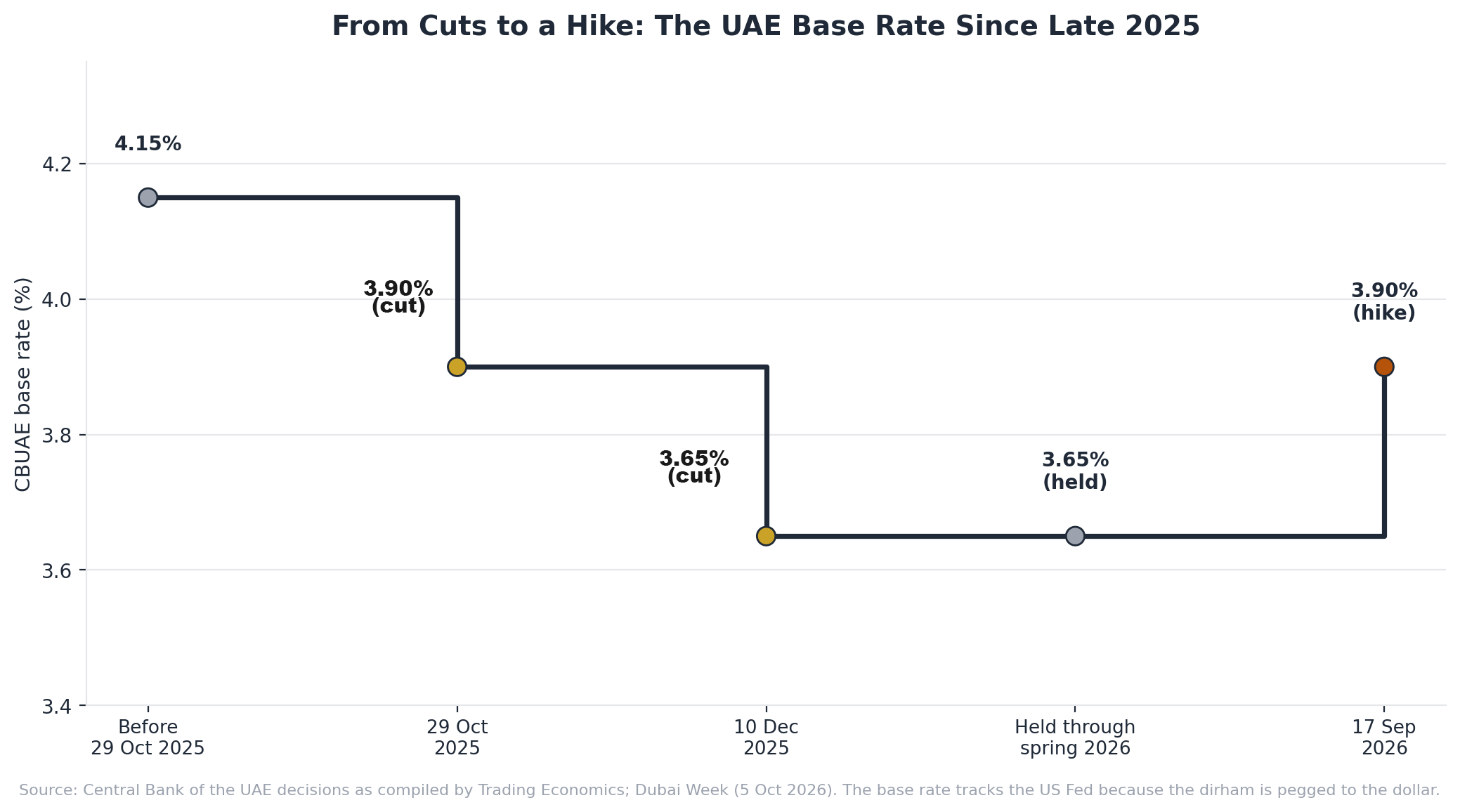
Fig. 1 — The UAE base rate fell in two steps in late 2025, was held through spring 2026, and rose 0.25 points on 17 September. Sources: Central Bank of the UAE decisions via Trading Economics; Dubai Week, 5 October 2026.
What matters for most mortgage holders is EIBOR, the interbank rate that variable mortgages are priced against. Three-month EIBOR was 4.00% on 3 September, 4.20% in the CBUAE fixing of 24 September and about 4.3% in early October, so it has moved up since the hike. The Fed's own projections add a further twist: a majority of officials expected another increase before the end of the year.
What 0.25 Points Costs, in Dirhams
One analyst quoted in the local press estimated that a 0.25-point rise adds about AED 210 a month to a AED 1.5 million mortgage with 25 years remaining. We ran the numbers ourselves and got a similar answer, between AED 214 and AED 231 a month depending on the starting rate.
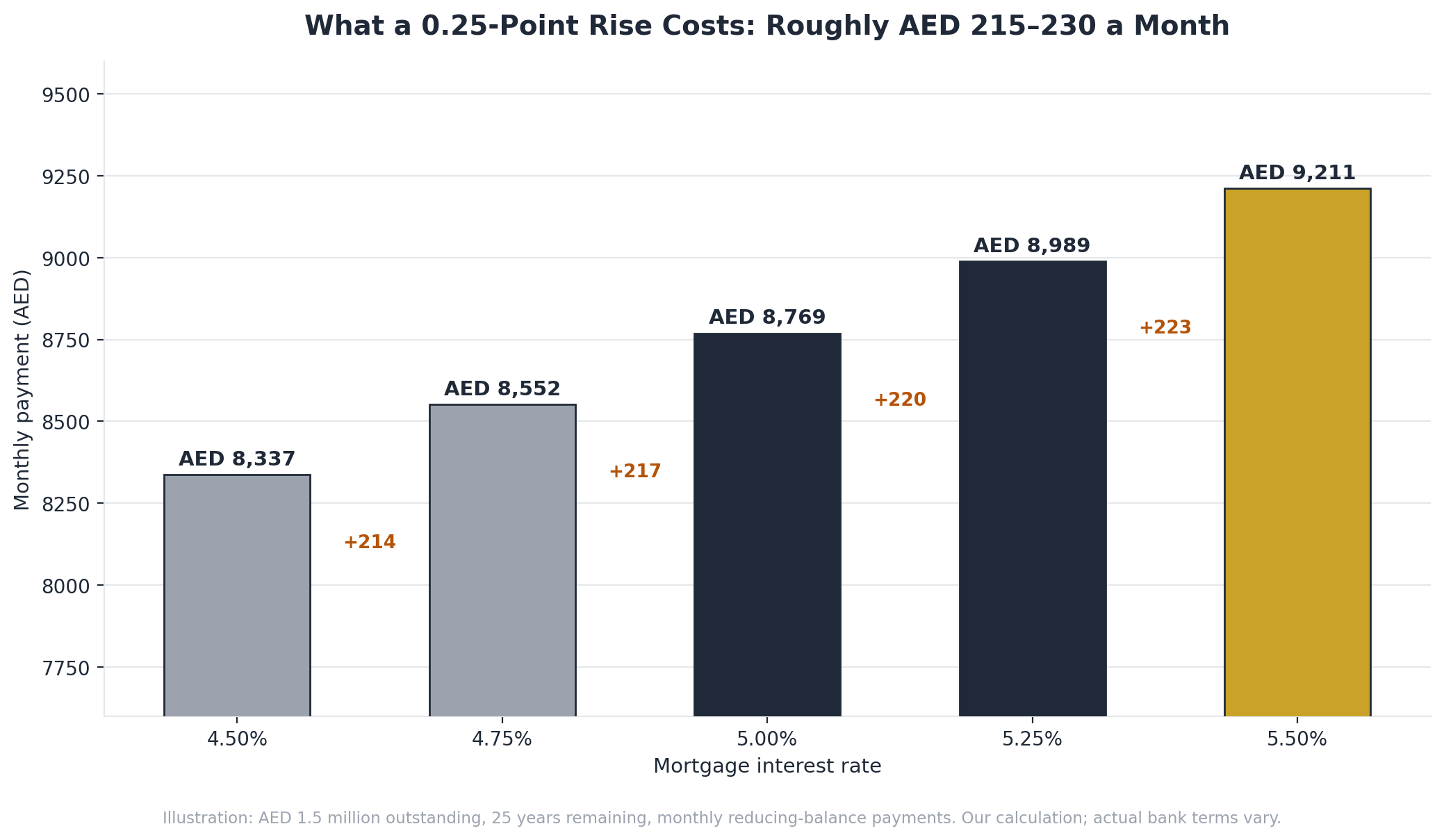
Fig. 2 — Monthly payment on a AED 1.5 million mortgage with 25 years remaining at different interest rates. Our calculation using standard reducing-balance payments; actual bank terms vary.
Put another way: a full percentage point, which is four 0.25-point steps, adds about AED 870 a month on the same loan, or around AED 10,500 a year. A single step is noticeable but manageable. Stacked steps are what change a household budget.
The Bigger Risk: When Your Fixed Rate Ends
Most UAE mortgages start with a fixed rate for one to five years and then revert to a floating rate set as a margin over EIBOR. That means the payment shock most borrowers face is not the 0.25-point hike. It is the jump on the day the fixed period ends, because the reversion rate is measured against today's higher EIBOR rather than the rates that prevailed when the loan was signed.
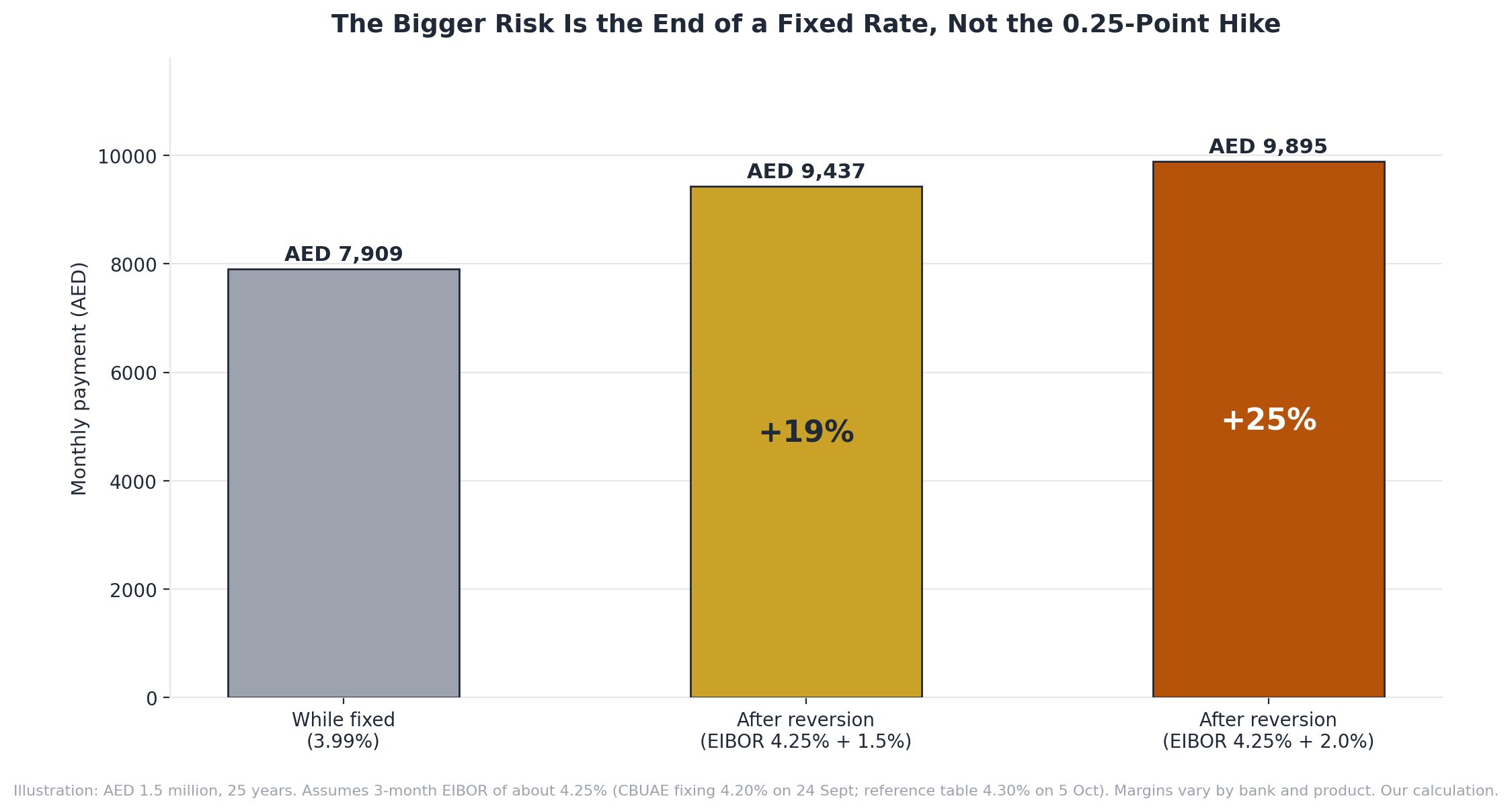
Fig. 3 — Illustration for a AED 1.5 million, 25-year mortgage: a 3.99% fixed rate reverting to 3-month EIBOR of about 4.25% plus a 1.5% or 2.0% margin. Margins vary by bank and product. Our calculation.
On those assumptions the monthly payment rises from about AED 7,900 to AED 9,400–9,900, an increase of roughly 19–25%. If your fixed period ends in the next year, this is the number to find out now, not on the day the letter arrives.
Who Feels It First
- Variable-rate borrowers. Payments track EIBOR, which has already moved up since the hike, though the effect arrives gradually as each reset date comes round.
- Borrowers whose fixed rate is about to end. The reversion calculation above applies directly to them.
- Buyers waiting on approval. Higher rates reduce the loan a given income can support, so an offer or pre-approval made weeks ago is worth rechecking against current terms.
- Off-plan buyers planning to finance at handover. The rate environment at the time the keys arrive, not today's, will set the terms, which is a reason to build in a buffer.
Cash buyers and borrowers mid-way through a fixed period are largely unaffected for now, which is one reason the effect on the property market is likely to be uneven rather than across the board.
September Mortgage Registrations Rose Anyway
The data from the month itself is more surprising than the headlines. Dubai Land Department figures show mortgage registrations of AED 16.79 billion across 4,266 transactions in September, against AED 14.36 billion across 3,390 in August: roughly 17% higher by value and 26% higher by number.
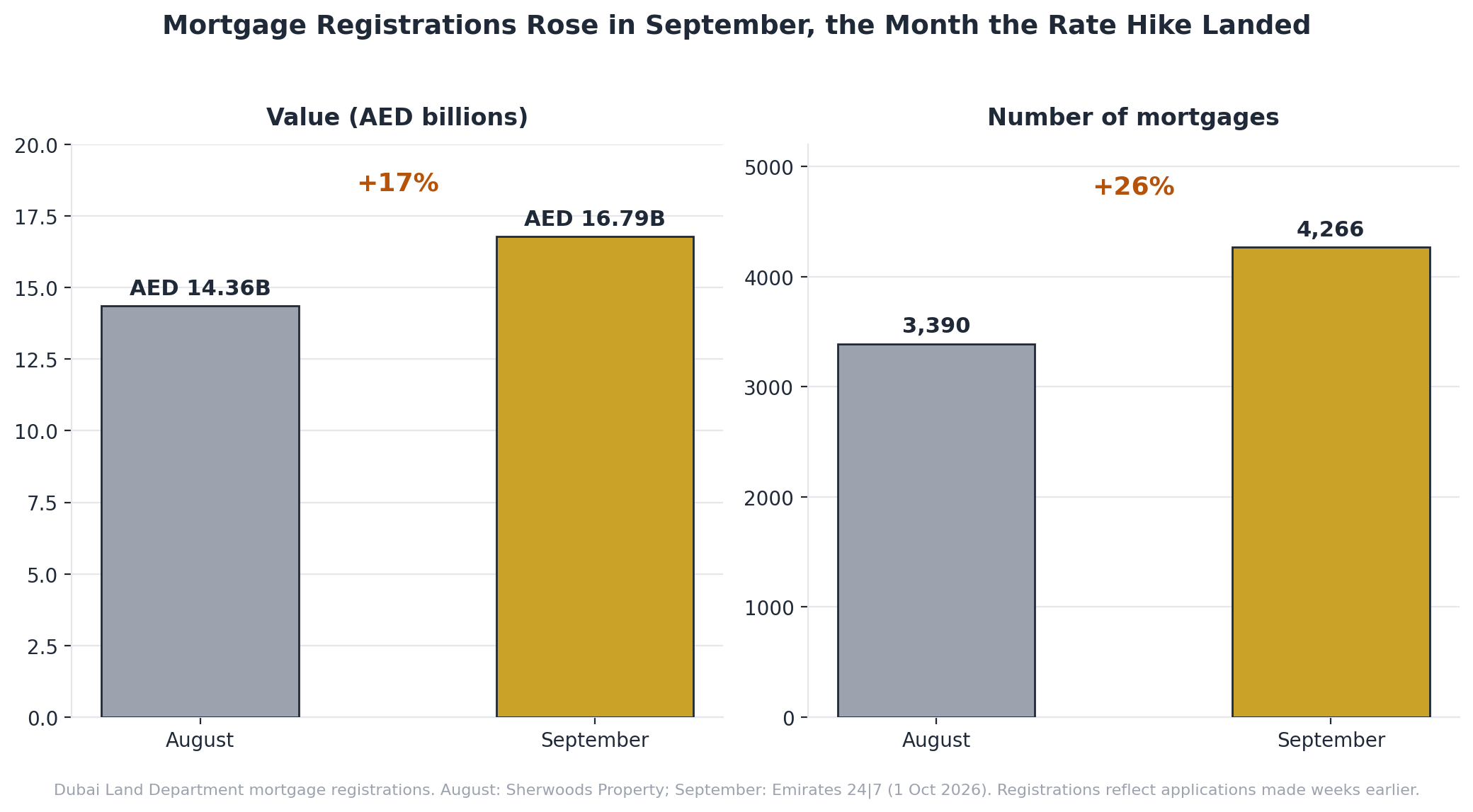
Fig. 4 — Dubai mortgage registrations in August and September 2026. Sources: Sherwoods Property (August); Emirates 24|7 reporting Dubai Land Department data (September).
It is too early to say why. Registrations lag applications by weeks, so September's figure largely reflects deals agreed before the hike. Some buyers may have moved to lock in financing ahead of an expected rise, and others may simply be returning as confidence recovers after the spring. October and November data will show whether the rise holds now that borrowing is more expensive. Treat any firm explanation, including ours, as a hypothesis for now.
What to Check Now
This is general information, not advice on your own finances, but these are the questions worth asking your bank or a mortgage adviser:
- When does my fixed period end, and what is the reversion margin? Get the exact formula in writing, then run it against current EIBOR.
- What would my payment be if rates rose a further full percentage point? On the example above, that is roughly AED 870 a month more. If that is uncomfortable, that is useful to know.
- What are the fixed-rate offers today compared with the floating alternative? Compare the total cost over the period you expect to hold the loan, not just the headline rate.
- What would it cost to switch or settle early? Early-settlement and transfer fees can change the sums.
- If I am buying, how much can I now borrow? Ask for a fresh affordability check at current rates rather than relying on an earlier one.
What It Means for the Property Market
Higher borrowing costs reduce affordability at the margin, and they land hardest on mortgage-financed buyers of ready homes, where lending is concentrated. Ready property now accounts for more than half of Dubai's sales by value, as we set out in our September 2026 market review, so the financing channel matters more than it did when off-plan payment plans dominated. Cash buyers, particularly at the top end, are largely insulated. The likely result is a market where financing costs add to the existing gap between communities rather than a uniform brake on prices.
What to Watch Next
- The Fed's remaining meetings this year. A majority of officials projected another hike, so a second increase is a live possibility.
- EIBOR. It follows the Fed with a small premium and is published daily by the Central Bank.
- Bank rate cards. Banks reprice fixed-rate products at different speeds, so offers can change within weeks.
- October mortgage registrations. The first full month after the hike will show whether September's rise was a pull-forward or a recovery.
The Bottom Line
The September hike is modest in isolation: about AED 215–230 a month on a AED 1.5 million loan. What makes it matter is the direction. Rates have turned up after a long easing period, more increases are possible, and the largest exposure sits with borrowers whose fixed rates are about to end. The practical step is to find out your own reversion terms and your own tolerance for a higher payment before you have to.
Have a specific purchase or mortgage question? Get in touch and we will walk through the numbers for your situation.
Frequently Asked Questions
Did UAE mortgage rates go up after the Fed hike?
The UAE Central Bank raised its base rate to 3.90% from 3.65% on 17 September 2026, a day after the Fed raised its target range to 3.75–4.00%. Variable mortgage rates follow EIBOR, which has risen since, while fixed-rate offers are repriced by each bank.
How much will my mortgage payment rise after the rate hike?
On a AED 1.5 million mortgage with 25 years remaining, a 0.25-point rise adds roughly AED 215–230 a month on our calculation. The effect on your loan depends on whether it is fixed or variable, when it next resets, and the balance and term remaining.
What is EIBOR and why does it matter for my mortgage?
EIBOR is the Emirates Interbank Offered Rate, the benchmark for lending between UAE banks. Variable-rate mortgages, and fixed-rate mortgages once their fixed period ends, are typically priced as a margin over EIBOR. Three-month EIBOR was about 4.2–4.3% in late September and early October 2026.
Should I fix or float my mortgage now?
That depends on your budget, your plans and your risk tolerance, and this article is not personal advice. The relevant factors are the gap between fixed and floating offers, how long you expect to keep the loan, switching and settlement costs, and the possibility that the Fed raises rates again this year.
Will the UAE raise interest rates again?
The UAE Central Bank moves in step with the US Federal Reserve because the dirham is pegged to the dollar. A majority of Fed officials projected another hike before the end of 2026, so a further UAE move is possible if the Fed follows through.
This article is general information, not financial or mortgage advice. Payment figures are our own illustrative calculations using standard reducing-balance formulas and the assumptions stated; actual rates, margins, fees and eligibility depend on your lender and circumstances. EIBOR changes daily; check the Central Bank of the UAE and your bank for current figures before making a decision.
